
Your outdoor lighting shouldn’t announce your security system. It should announce your taste. Yet across countless New York rooftops and estates, the same story repeats itself: harsh floodlights that kill the ambiance the moment the sun goes down, fixtures that corrode after a single coastal season, and a separate app that has nothing to do with the rest of your smart home. If you’ve ever stood on your terrace at night and felt like you were inside a parking garage, you already know the problem with conventional landscape lighting design in NYC.
You’re right to want something better. The good news is that bespoke outdoor lighting has evolved far beyond simply choosing fixtures and burying cable. Today’s most sophisticated installations function as an invisible layer of technology woven directly into your home’s architecture and automation ecosystem, delivering resort-like atmosphere, intelligent security, and complete control from a single voice command or a tap on your phone.
In this guide, you’ll discover exactly how integrated landscape lighting design transforms New York properties in 2026, from the fixtures built to survive salt air and urban weather to the smart systems that make managing every scene effortless.
Key Takeaways
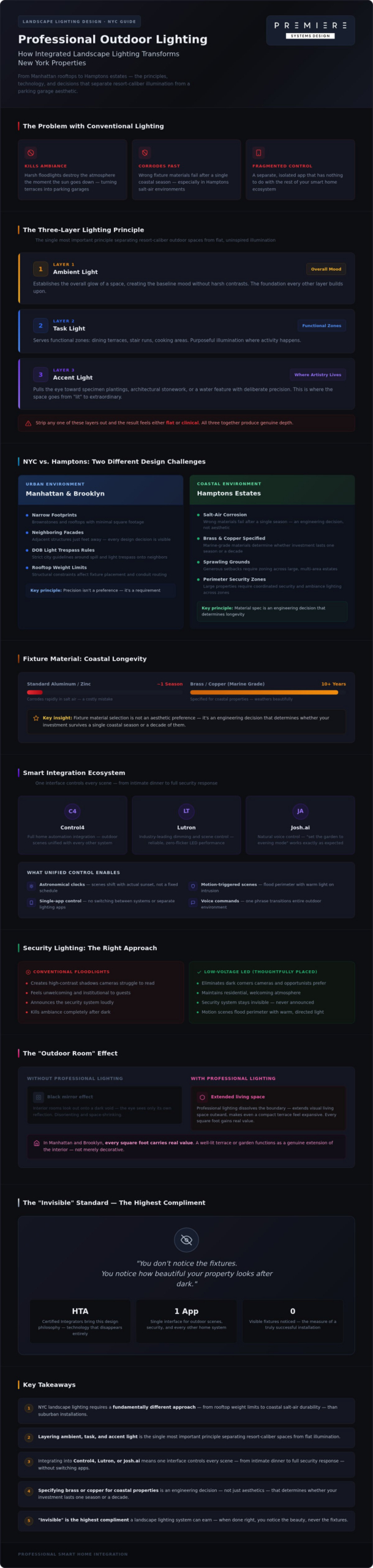
- Professional landscape lighting design NYC requires a fundamentally different approach than suburban installations — from rooftop weight limits to coastal salt-air durability — and this guide covers exactly how to navigate both environments.
- Layering ambient, task, and accent light is the single most important principle separating resort-caliber outdoor spaces from flat, uninspired illumination.
- Integrating your outdoor lighting into a unified Control4, Lutron, or Josh.ai ecosystem means one interface controls every scene — from an intimate dinner setting to a full security response — without switching between apps.
- Fixture material selection is not an aesthetic preference alone; specifying brass or copper for Hamptons properties is an engineering decision that determines whether your investment survives a single coastal season or a decade of them.
- HTA-certified integrators bring a design philosophy where the technology disappears entirely — you’ll discover why “invisible” is the highest compliment a landscape lighting system can earn.
The Impact of Professional Landscape Lighting Design in NYC
At its core, landscape lighting design is the strategic application of light to reveal, enhance, and protect the architecture and natural elements of an outdoor space. Done well, it’s invisible. You don’t notice the fixtures; you notice how beautiful your property looks after dark. Done poorly, it reduces a carefully curated outdoor space to something that resembles a construction site at 11 PM.
New York properties demand a fundamentally different approach than suburban estates. A five-bedroom home in Westchester has the luxury of sprawling grounds, generous setbacks, and forgiving sightlines. A Brooklyn brownstone or a Manhattan rooftop operates under entirely different constraints: narrow footprints, neighboring facades just feet away, strict DOB guidelines around light trespass, and an urban visual context that makes every design decision highly visible. Landscape lighting design NYC professionals understand that here, precision isn’t a preference; it’s a requirement.
There’s also a psychological dimension that’s easy to overlook. When interior rooms look out onto a dark void at night, the effect is disorienting. The eye sees only a black mirror reflecting the room back at you. Professional lighting dissolves that boundary, extending your visual living space outward and making even a compact terrace feel expansive. It transforms what was a wall of darkness into a curated view.
Extending Your Living Space After Dark
The “outdoor room” concept has become central to high-end residential design across Manhattan and Brooklyn, where every square foot carries real value. A well-lit terrace or garden isn’t just decorative; it functions as a genuine extension of the interior. Professional designers create visual depth on narrow townhome lots by layering light at multiple heights, drawing the eye through the space rather than stopping it at the nearest surface. Automated astronomical clocks handle the transition from day to night seamlessly, adjusting scenes in real time based on the actual sunset rather than a fixed schedule, so your outdoor environment always looks intentional rather than forgotten.
Security Through Sophisticated Illumination
The distinction between security lighting and beautification lighting that provides security is significant. Harsh floodlights create high-contrast shadows that cameras struggle to read and that guests find unwelcoming. Low-voltage LED fixtures, positioned thoughtfully, eliminate the dark corners that both cameras and opportunists prefer, while maintaining an atmosphere that feels residential rather than institutional. When integrated with surveillance systems, landscape lighting becomes a proactive deterrent: motion-triggered scenes can flood a perimeter with warm, directed light without ever announcing that a security system is doing the work.
The Core Principles of Architectural Landscape Lighting
Great landscape lighting design isn’t about adding more light. It’s about adding the right light, in the right place, at the right intensity. The difference between a property that looks genuinely extraordinary after dark and one that simply looks “lit” comes down to three foundational principles: layering, composition, and cohesion. Master these, and the technology disappears entirely. What remains is atmosphere.
Layering means building your lighting scheme across three distinct planes. Ambient light establishes the overall glow of a space, creating the baseline mood without harsh contrasts. Task lighting serves functional zones: a dining terrace, a stair run, a cooking area. Accent light is where artistry lives, pulling the eye toward specimen plantings, architectural stonework, or a water feature with deliberate precision. Strip any one of these layers out, and the result feels either flat or clinical. All three together produce the kind of depth that makes guests stop and notice how good a space looks without ever identifying why.
Composition works exactly the way it does in interior design: you need focal points. A mature Japanese maple, a limestone garden wall, a custom steel pergola, these are your anchors. Professional landscape lighting design NYC practices treat these elements the way a portrait photographer treats a subject, directing attention rather than flooding everything equally. Uniformity is the enemy of drama.
Cohesion is a detail that separates truly refined installations from competent ones. Your outdoor lighting temperature should complement, not fight, the interior lighting visible through your windows and glass doors. When warm interior light meets a cool blue exterior, the visual disconnect is immediate and jarring. Aligning both environments creates a seamless visual extension of your luxury home that reads as intentional from every vantage point.
On sustainability, the 2026 standard for high-end installations is unambiguous: high-efficiency LED fixtures paired with dark-sky-compliant optics that direct light downward rather than scattering it into the night sky. This isn’t just responsible design; in dense urban environments, it’s increasingly expected by neighbors, co-op boards, and municipal guidelines alike.
Mastering Light Direction and Technique
Direction is one of the most powerful variables in a designer’s toolkit, and it’s routinely underused. Up-lighting placed at the base of a tree creates drama and vertical scale, but it can feel theatrical if overused. “Moonlighting,” where fixtures are mounted high in a tree canopy and aimed downward, replicates the soft, dappled quality of natural moonlight filtering through branches. For New York rooftop gardens and townhome courtyards, it’s one of the most elegant techniques available.
Grazing, the practice of placing a fixture very close to a surface and angling light nearly parallel to it, reveals texture in ways that frontal illumination never can. On a Brooklyn brownstone facade or a Hamptons fieldstone wall, grazing transforms a flat surface into something with genuine visual depth. Silhouetting works in the opposite direction: place light behind a sculptural plant or architectural element, and the subject becomes a dramatic shape against a glowing backdrop.
Path lighting deserves particular care. Fixtures that are too bright or too tall become the focal point themselves rather than guiding the eye. The goal is safe, clearly defined navigation with fixtures that are noticed only when you look directly at them. Low-profile bollards, recessed step lights, and in-ground fixtures set flush with paving all achieve this without interrupting the visual flow of the space.
The Importance of Color Temperature
Color temperature is where many otherwise well-planned installations quietly fail. The sweet spot for residential luxury is between 2700K and 3000K, a warm, golden range that flatters skin tones, enriches plant colors, and feels genuinely welcoming. Cool white LEDs in the 4000K to 5000K range produce a clinical, almost institutional quality that no amount of premium fixtures can overcome. They signal “efficiency” when you want to signal “elegance.”
CRI, or Color Rendering Index, is equally critical: a high CRI rating (90 or above) means colors appear true and saturated rather than washed out, so the deep green of a boxwood hedge and the warm grey of bluestone pavers actually look the way they should. Specify anything lower, and your carefully chosen plantings and materials lose the very qualities you paid for.
If you’re planning a new installation or reassessing an existing one, consulting with a professional integrator who coordinates with your architect and landscape designer ensures every technical decision serves the overall design vision rather than working against it.
Smart Integration: Control4, Lutron, and Josh.ai Outdoors
The most common failure in outdoor lighting isn’t a fixture choice or a wiring decision. It’s the interface. A beautifully designed landscape loses half its value the moment you’re managing it through a separate app that has no relationship to the rest of your home. True luxury means one environment, one interface, and zero friction between your intention and the result.
When your smart home installation is designed correctly, your outdoor lighting isn’t a separate system. It’s a seamless extension of the same ecosystem controlling your interior shades, climate, and audio. The distinction matters enormously in practice: rather than opening a dedicated lighting app after dinner, you simply tell the room what you want it to become.
Outdoor scenes are where this integration becomes genuinely transformative. A well-configured system might include:
- Entertaining mode: Perimeter path lights at 60%, specimen trees up-lit at full intensity, dining terrace at a warm 40% that flatters every face at the table.
- Relaxation mode: Accent lighting dimmed to near-off, soft ambient glow along the roofline, a quiet transition that signals the evening is winding down.
- Security mode: Full perimeter illumination activated automatically by motion, coordinated with your surveillance system, without a single button press from you.
Geofencing adds another layer of intelligence that’s particularly valuable for landscape lighting design NYC clients with busy schedules. Your driveway and entry sequence can activate the moment your phone crosses a defined boundary on the way home, so the property is always lit and welcoming before you arrive. No timers to adjust seasonally. No arriving to a dark gate.
Reliable enterprise-grade networking and Wi-Fi infrastructure is what makes all of this work consistently outdoors. Consumer-grade access points simply can’t maintain the signal integrity needed across a Hamptons estate or a Manhattan rooftop terrace in variable weather. Properly specified outdoor networking infrastructure ensures your control system responds the same way at 11 PM in January as it does on a clear July evening.
Voice Control with Josh.ai
Josh.ai has become the preferred voice platform for high-net-worth clients precisely because it was built with privacy as a foundational principle, not an afterthought. Commands are processed locally rather than routed through third-party servers, which matters when your home is your most private environment. Saying “Josh, set the patio to entertaining” while poolside adjusts your lighting, queues your outdoor audio, and confirms the scene without broadcasting your preferences to a cloud platform. It also integrates natively with outdoor climate and audio systems, so a single natural language command can orchestrate the entire outdoor experience simultaneously.
Lutron and Control4 Ecosystems
Premiere Systems Design recommends Lutron for precision dimming in architectural settings because its performance at low dim levels is simply unmatched. Fixtures hold a smooth, flicker-free output down to near-zero, which is essential when you’re dialing a terrace scene to 15% for a candlelit dinner. As a Control4 Authorized Gold Dealer, Premiere designs unified outdoor experiences where lighting, audio, surveillance, and climate share a single control layer. Remote monitoring and over-the-air firmware updates mean the system stays stable and current long after installation day, without requiring a service visit every time a software update is released.
NYC Design Challenges: Rooftops vs. Hamptons Estates
No two landscape lighting design NYC projects present identical constraints. A penthouse terrace in Tribeca and a waterfront estate in Southampton share the same ambition, but the engineering decisions separating a successful installation from a costly mistake are entirely different in each environment. Understanding those differences before a single fixture is specified is what separates a genuine expert from a competent generalist.
Urban installations live inside a web of structural, regulatory, and neighborly obligations that suburban projects simply don’t face. Rooftop weight limits are a real engineering boundary: every planter, pedestal, and fixture assembly contributes to the dead load calculation, and exceeding it isn’t a design problem, it’s a building code violation. Experienced integrators work directly with structural engineers and DOB filings to confirm what the slab can carry before any product selection happens. Light trespass is equally non-negotiable. On a dense Manhattan townhouse block, a fixture aimed even slightly off-axis can project directly into a neighbor’s bedroom window. Specifying fixtures with tight beam angles and full-cutoff optics isn’t just considerate; it’s increasingly expected under New York City’s evolving outdoor lighting standards.
Coordination with architects and builders is where these constraints get resolved elegantly rather than retrofitted awkwardly. When Premiere Systems Design is engaged during the design phase of a renovation or new construction, conduit pathways, junction box placements, and structural penetrations are planned before the contractor pours concrete or lays stone. The result is a finished installation with no visible wiring, no surface-mounted conduit, and no compromises.
Manhattan Rooftops and Terraces
High-rise terraces introduce a challenge that ground-level installations never face: wind load. Fixtures on an exposed rooftop at elevation thirty stories above street level experience lateral forces that can loosen standard mounting hardware over a single winter season. Specified correctly, low-profile fixtures with concealed fasteners and weighted bases designed for wind-rated environments solve this without visual compromise. Wiring routed beneath pedestal pavers or through pre-planned conduit keeps every surface clean, and fixture heights are deliberately kept below parapet lines so nothing interrupts the skyline view that made the property worth buying in the first place.
Hamptons and Long Island Estates
Coastal properties demand a different discipline entirely. Salt air accelerates corrosion at a rate that renders standard aluminum fixtures visually degraded within a single season. Brass and copper aren’t premium upgrades in this context; they’re the baseline specification for any installation expected to perform over a decade. Beyond material selection, large estates introduce scale challenges: illuminating a mature specimen oak or a three-hundred-foot driveway requires transformer capacity planning and cable voltage-drop calculations that smaller urban projects never require. “Night aiming,” the practice of adjusting fixture aim angles after dark with the full scene active, is essential on expansive properties where glare from a poorly aimed fixture can wash out the very view it was meant to enhance. It’s a detail that rarely appears in a proposal but defines the quality of the finished result.
Whether your project is a rooftop terrace in the West Village or a gated waterfront estate in East Hampton, the engineering precision behind the design is what makes the finished environment feel effortless. Connect with Premiere Systems Design to discuss how we coordinate with your architect and builder from the ground up.
The Premiere Approach: Invisible Technology for the Smartest Home
Founded in 1996, Premiere Systems Design has spent nearly three decades refining a single conviction: the best technology is the technology you never notice. Fixtures that disappear into the architecture. Scenes that shift before you think to adjust them. A system so well-integrated that guests compliment your property without ever registering that a sophisticated platform is orchestrating every element of what they’re experiencing. That’s the standard every landscape lighting design NYC project is held to.
HTA certification is the credential that separates serious custom integrators from capable installers. The Home Technology Association’s certification process evaluates not just technical competency, but design philosophy, client communication, and systems integration across disciplines. For clients investing in a property where landscape lighting, surveillance, audio, and climate control must function as a single coherent environment, that distinction matters. It’s the difference between a team that knows how to install products and a team that knows how to design experiences.
Premiere’s process reflects that philosophy from the first conversation. The initial consultation isn’t a product presentation; it’s a listening exercise. Understanding how you use your outdoor space, what you want it to feel like at 7 PM versus midnight, and how it connects to the interior environments you’ve already invested in, these are the inputs that drive every subsequent decision. Fixture selection, control programming, and scene configuration all follow from that foundation rather than preceding it.
Final programming is where the system earns its reputation. Every scene is tuned on-site, after dark, with the full environment active. Aim angles are adjusted, intensity levels are balanced against ambient conditions, and voice command triggers are tested across real-world scenarios. Nothing is assumed from a specification sheet.
Live Smarter with Integrated Design
Electrical contractors and landscape designers each bring expertise to an outdoor project, but neither speaks the other’s language fluently. Premiere bridges that gap by serving as the single point of contact who coordinates with both, ensuring conduit placement, transformer locations, and fixture specifications are resolved before they become field problems. Your landscape lighting doesn’t exist in isolation; it’s part of the same ecosystem governing your interior shades, climate, and audio. As your smart home evolves, your outdoor system evolves with it, through remote updates and proactive maintenance planning that keeps every component performing at specification.
Your Smartest Home on the Block
A property lit with this level of precision doesn’t just look beautiful. It holds its value differently, presents to guests differently, and functions differently at every hour of the day. That’s the Premiere commitment: luxury that’s reliable, sophistication that’s invisible, and a finished result that quietly announces the quality of everything behind it.
Schedule your landscape lighting consultation with Premiere Systems Design and discover what your property looks like when the technology disappears entirely.
Your Outdoor Space Deserves More Than an Afterthought
Landscape lighting design NYC demands more than a handful of fixtures and a buried cable run. It requires layered technique, materials engineered for your specific environment, and a control ecosystem that works in concert with every other system in your home. Whether your property is a Tribeca rooftop or a waterfront estate in Southampton, the principles are the same: precision, cohesion, and technology that quietly disappears into the background.
The properties that hold their value, impress guests, and genuinely feel extraordinary after dark all share one thing: a team that treated the outdoor environment as seriously as the interior. As an HTA-Certified integrator, Control4 Authorized Gold Dealer, and bespoke design practice since 1996, Premiere Systems Design brings that standard to every project.
Your outdoor space has the potential to become your home’s most compelling room. All it takes is the right partner to design it. Elevate your outdoor environment with a bespoke lighting consultation and discover what your property looks like when the technology truly disappears.
Frequently Asked Questions About Landscape Lighting Design in NYC
How much does landscape lighting design cost in NYC?
Costs vary significantly based on scope, fixture specification, and integration complexity, so it’s difficult to quote a meaningful range without understanding your specific property. A compact Manhattan terrace with smart control integration is a fundamentally different project than a multi-acre Hamptons estate requiring transformer capacity planning and extensive cable runs. What’s consistent across high-end installations is that fixture quality, materials, and control programming represent the majority of the investment, not labor alone.
The most useful step is a consultation with an experienced integrator who can assess your property’s actual requirements before any numbers are discussed. Attempting to budget from industry averages often leads to either underspecifying the system or being surprised by scope additions mid-project.
Do I need a special permit for outdoor lighting on a Manhattan rooftop?
Permit requirements depend on the nature and scale of your installation. Electrical work in New York City generally requires licensed electricians and may involve DOB filings, particularly for new conduit runs or significant load additions. Beyond permits, rooftop projects must respect light trespass standards and co-op or condo board restrictions that can be more stringent than city code alone.
Engaging an integrator who coordinates directly with your architect and building management from the outset resolves these questions before they become costly field problems. Retroactively addressing compliance issues after fixtures are installed is significantly more disruptive than planning for them upfront.
Can I add smart control to my existing landscape lighting system?
In many cases, yes, though the answer depends on your current wiring infrastructure and transformer capacity. Existing low-voltage systems can often be retrofitted with smart controllers that integrate into platforms like Control4 or Lutron, giving you scene programming and automation without replacing every fixture. The key variable is whether your existing wiring supports the communication protocols the new control layer requires.
A professional assessment is the only reliable way to determine what’s feasible. Some retrofits are straightforward; others reveal infrastructure limitations that make a phased upgrade more practical than a direct integration. Either way, the goal is the same: one interface for your entire outdoor environment.
What is the best color temperature for luxury outdoor lighting?
The 2700K to 3000K range is the standard for high-end residential landscape lighting design NYC professionals specify consistently. This warm, golden output flatters skin tones, enriches plant colors, and produces an atmosphere that feels genuinely welcoming rather than institutional. Pair that with a CRI rating of 90 or above, and your plantings, stonework, and architectural details will read with the depth and saturation you actually paid for.
Cooler temperatures in the 4000K to 5000K range are appropriate for commercial and utility contexts, not for a terrace where you’re hosting dinner. No fixture quality or design technique can compensate for a color temperature that signals efficiency when the goal is elegance.
How does landscape lighting improve home security?
Thoughtfully placed landscape lighting eliminates the dark corners that surveillance cameras struggle to capture and that opportunists prefer. The goal isn’t raw brightness; it’s eliminating contrast shadows that create blind spots. Low-voltage LED fixtures positioned at entry points, along perimeter pathways, and near access gates provide consistent, camera-friendly illumination that works as a passive deterrent around the clock.
When integrated with your surveillance system through a platform like Control4, lighting becomes an active security tool. Motion-triggered scenes can illuminate a full perimeter automatically, coordinating with your cameras without requiring any manual intervention from you. The security response happens invisibly, exactly as it should.
What maintenance is required for high-end outdoor lighting systems?
Well-specified LED fixtures have long operational lifespans, so maintenance is less frequent than with older lamp-based systems. That said, coastal properties require periodic inspection of fixture seals and hardware, particularly brass and copper fittings exposed to salt air, to confirm corrosion hasn’t compromised connections. Aim angles should also be checked seasonally, since plantings grow and shift the visual relationships the original design was calibrated around.
On the control side, Premiere Systems Design provides remote monitoring and over-the-air firmware updates that keep your system current without requiring a service visit for every software release. Proactive maintenance planning, rather than reactive repairs, is what keeps a sophisticated installation performing at specification year after year.
Is LED landscape lighting bright enough for large Hamptons estates?
Absolutely. Modern high-output LED fixtures deliver more than sufficient lumen output for illuminating specimen trees, long driveway approaches, and expansive lawn areas. The more relevant engineering consideration on large estates isn’t brightness; it’s transformer capacity planning and voltage-drop calculations across extended cable runs. Undersized transformers and long runs without proper wire gauge selection produce dim, inconsistent output at the far end of a circuit regardless of fixture quality.
Properly engineered installations account for these variables at the design stage, ensuring every fixture performs exactly as specified whether it’s twenty feet or two hundred feet from the transformer. This is where working with an integrator experienced in estate-scale projects makes a measurable difference in the finished result.
Can I control my landscape lights with voice commands like Josh.ai?
Yes, and for clients who’ve experienced it, it becomes one of the most natural parts of managing an outdoor environment. Josh.ai integrates natively with landscape lighting systems, allowing you to call up any programmed scene with a simple spoken command. Because Josh.ai processes commands locally rather than routing them through external servers, your preferences and patterns stay private, which matters when your home is your most personal environment.
The practical experience is seamless: saying “Josh, set the garden to entertaining” while you’re still inside adjusts every fixture in the sequence simultaneously, without unlocking a phone or opening an app. It’s the kind of effortless control that makes the technology genuinely disappear into the background of your life.