
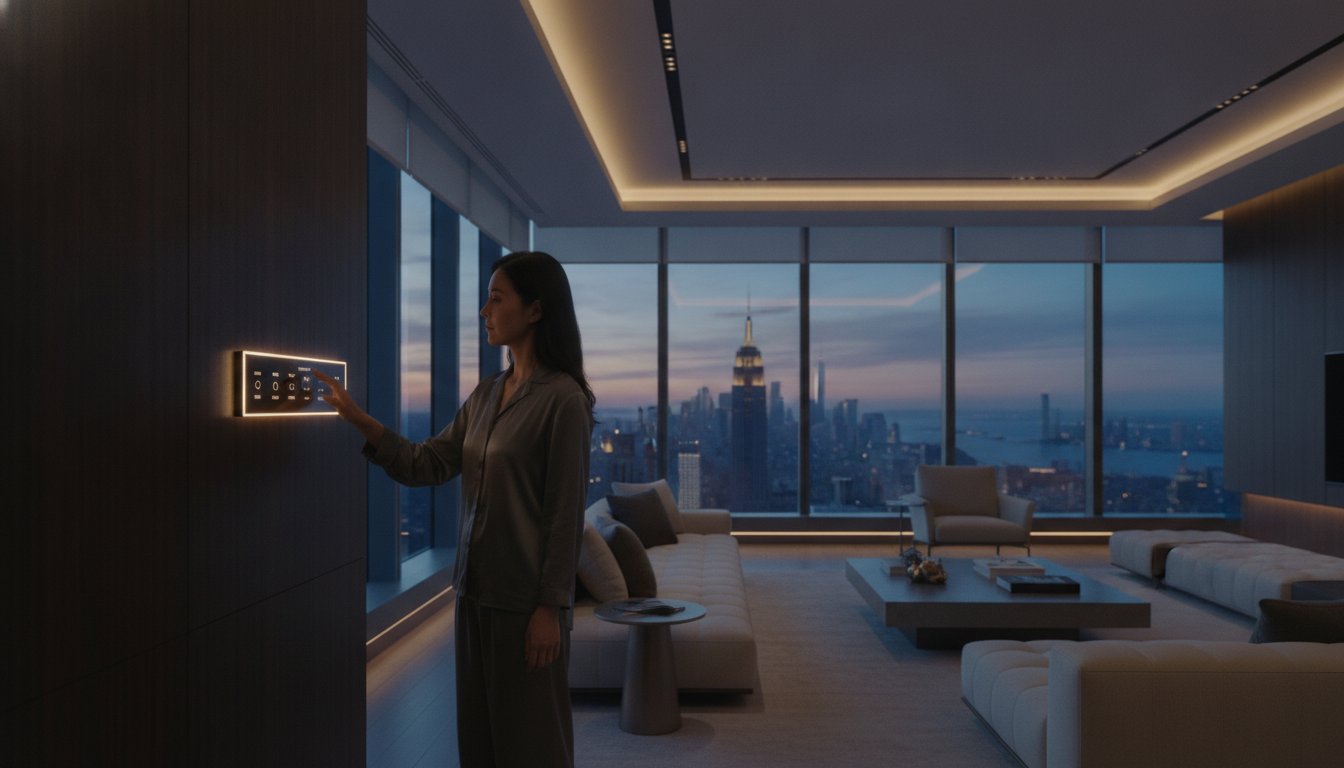
You spent your Saturday morning trying to sync a new smart bulb, yet you still need three different apps just to dim the lights and lower the shades for a movie. If your high-end Manhattan apartment feels more like a tech support desk than a sanctuary, you aren’t alone. It’s frustrating when expensive devices refuse to communicate, especially when thick NYC masonry walls turn your Wi-Fi into a series of dead zones. You deserve an environment that responds to your needs at a touch, not a collection of gadgets that requires a manual to operate.
The decision to upgrade from DIY smart home to professional NYC systems is about reclaiming your time and your home’s aesthetic. This guide reveals how to transition from fragmented technology to a seamless, invisible ecosystem designed specifically for the complexities of New York living. We’ll explore how to unify your lighting, climate, and entertainment into one intuitive interface while navigating the latest 2026 DOB attestation requirements and electrical codes. It’s time to stop managing your home and start living in it. Discover how to create the smartest home on the block where true luxury is felt, not seen.
Key Takeaways
- Understand why consumer gadgets hit a performance ceiling and how localized processing ensures your home stays responsive even when the cloud fails.
- Learn how enterprise-grade networking overcomes the unique challenges of NYC masonry walls to provide seamless, high-speed connectivity in every room.
- Discover how to eliminate “wall acne” by replacing cluttered plastic switches with elegant, custom-engraved keypads and invisible technology.
- Navigate the complexities of 2026 NYC building regulations, including new DOB attestation rules and the necessity of HTA-certified professionals for board approvals.
- Plan your upgrade from DIY smart home to professional NYC systems with a partner who prioritizes your lifestyle and interior design over mere hardware.
The DIY Ceiling: Why Consumer Gadgets Fail in Luxury NYC Homes
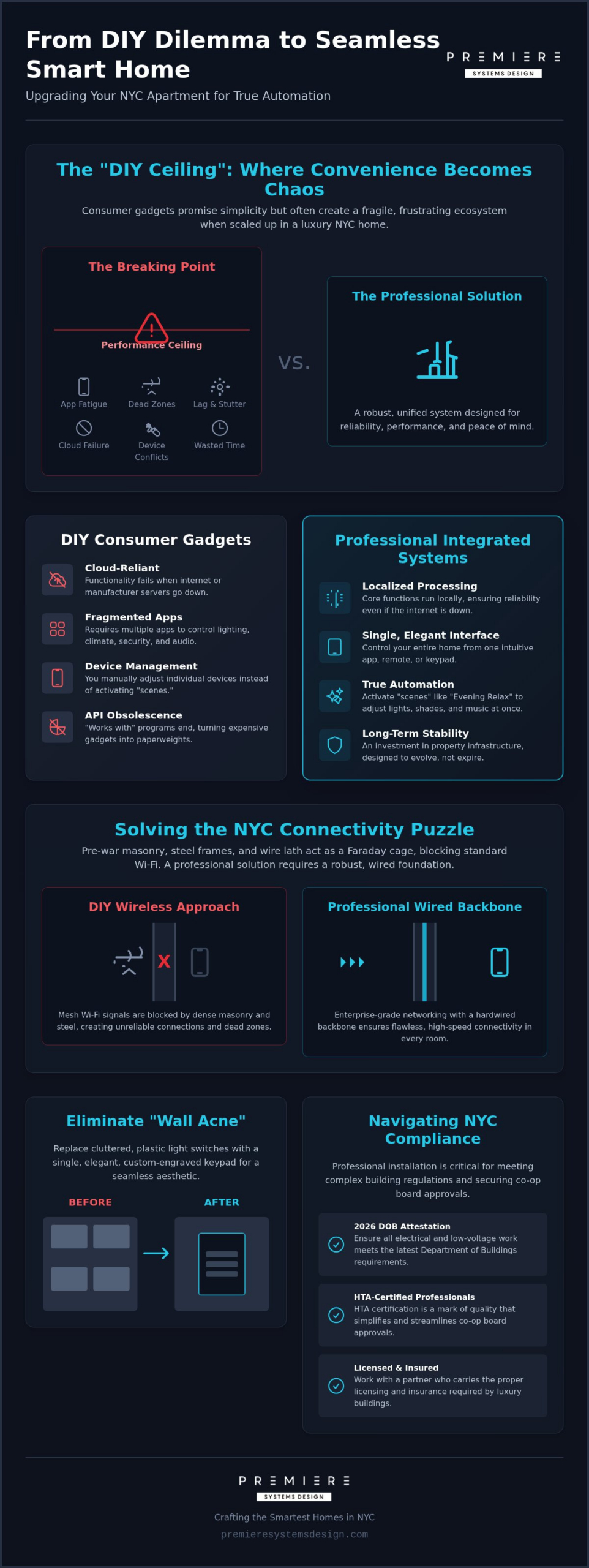
Many Manhattan homeowners begin their journey with a few smart bulbs and a video doorbell. It feels like progress until the system begins to stutter under its own weight. This is the “DIY Ceiling,” a point where the sheer volume of devices outpaces the processing power of a standard consumer router. While a basic mesh network might handle a laptop and a few phones, it quickly falters when asked to manage forty light switches, six motorized shades, and a multi-room audio system simultaneously. When your network reaches this limit, responsiveness drops, and the very technology meant to simplify your life becomes a source of daily friction.
The fragility of these setups often stems from their heavy reliance on the cloud. When your internet connection hiccups or a manufacturer’s server goes down, your home loses its intelligence. Professional home automation systems utilize localized processing, ensuring your environment remains responsive and secure even if the outside world goes offline. This reliability is paramount for those who value peace of mind over the novelty of a gadget. Choosing to upgrade from DIY smart home to professional NYC systems ensures that your home functions with the same consistency as your water or electricity.
App fatigue is the inevitable symptom of a fragmented home. Opening one app for the thermostat, another for the security cameras, and a third for the music is the opposite of luxury; it’s a second job. True integration means moving away from these digital silos toward a single, elegant interface. Furthermore, the rapid obsolescence of consumer tech means that expensive DIY thermostats or locks can become “paperweights” within a few years as software support wanes. A professional system is an investment in your property’s infrastructure, designed to evolve rather than expire.
The Fragility of Consumer APIs
We have seen major tech giants retire “Works with” programs overnight, leaving thousands of homeowners with disconnected devices. This is known as API obsolescence, which is the failure of the software bridges that allow different gadgets to communicate. When these bridges break, your “smart” routines fail without warning. In contrast, the stability of Control4 lighting offers a long-term solution that prioritizes architectural integrity over fleeting tech trends. Your home should be built on a foundation that lasts for decades, not just until the next software update.
Management vs. Automation
DIY systems require you to manage your home. You spend your evening toggling individual switches and adjusting sliders to get the mood right. When you upgrade from DIY smart home to professional NYC standards, you move toward true automation. Instead of managing devices, you activate “scenes.” A single command like “Evening Relax” can simultaneously dim the living room pendants, close the motorized shades, and initiate a curated playlist across your entire floor plan. It’s the difference between operating machinery and enjoying a lifestyle that anticipates your every need.
The NYC Infrastructure Gap: Solving the Pre-War Connectivity Puzzle
The physics of a Manhattan luxury apartment are often the greatest enemy of a DIY smart home. While a mesh Wi-Fi system might work in a suburban drywall home, it rarely survives the transition to a pre-war co-op. NYC buildings are constructed with dense masonry, steel-frame structures, and plaster walls reinforced with wire lath. This lath acts as a Faraday cage, effectively blocking wireless signals from moving between rooms. When you attempt to upgrade from DIY smart home to professional NYC standards, you quickly realize that wireless convenience depends entirely on a wired foundation.
Enterprise-grade networking is the only way to overcome high-density RF interference. In a typical Manhattan neighborhood, your devices aren’t just competing with each other; they’re fighting against hundreds of neighboring routers for the same narrow frequency bands. A professional installer ensures your system is tuned to cut through this digital noise. The goal is a hardwired backbone where every high-bandwidth device, from your 4K television to your automation processor, has a direct physical connection. This leaves the wireless spectrum clear for the devices that actually need it, like your tablet or phone.
The best wireless experience is actually 90% wired. By running fiber or shielded copper to strategic points throughout your floor plan, we eliminate the latency and dropouts that plague consumer-grade setups. This infrastructure is the invisible engine that powers your lifestyle, ensuring that a command given in the bedroom reaches the kitchen instantly. It’s about moving from a system that works “most of the time” to one that matches the reliability of your utility services.
Enterprise-Grade Networking
A robust home network is the most critical component of your modern security and lifestyle. Standard consumer routers lump your smart fridge, guest phones, and private data onto a single network, creating significant security vulnerabilities. Professional systems utilize Virtual Local Area Networks (VLANs) to isolate your IoT traffic. This separation ensures that a vulnerability in a smart bulb doesn’t provide a gateway to your personal financial records or private family photos.
Pre-War Architectural Challenges
Preserving the aesthetic of a landmarked building requires more than just technical skill; it requires surgical precision. Running cables through twelve-inch thick plaster walls without damaging crown molding is an art form. Professional integrators use specialized tools to bypass these obstacles while adhering strictly to the NYC Electrical Code. If you’re planning a renovation, consulting with a professional integrator early in the process ensures your technology is invisible and your architecture remains untouched. These systems aren’t just installed; they’re engineered to respect the history of your home while providing the performance of the future.
Eliminating Wall Acne: The Aesthetic of Invisible Technology
True luxury is often defined by what you don’t see. In many high-end Manhattan residences, the beauty of custom millwork and hand-applied wall finishes is frequently interrupted by “wall acne.” This term describes the unsightly cluster of mismatched plastic dimmers, bulky thermostats, and plastic intercom stations that accumulate in a DIY setup. This visual clutter is the hidden cost of a fragmented system. When you upgrade from DIY smart home to professional NYC standards, the primary goal is to strip away this technological noise, leaving only the architecture and your personal style to take center stage.
Consolidation is the antidote to this clutter. By replacing a row of five or six plastic switches with a single, custom-engraved Lutron keypad, you reclaim the architectural purity of your walls while gaining more sophisticated control. These keypads are available in finishes that complement your interior palette, from brushed brass to minimalist stone. When considering the Smart Home Installation Cost a Complete Budgeting Guide, it’s helpful to view these upgrades as an investment in your home’s permanent design rather than just a tech purchase. These interfaces are engineered to feel like a natural extension of the room’s decor.
The luxury of concealment extends beyond the walls. Professional integration allows for invisible speakers that are plastered over and painted to match the ceiling, providing high-fidelity audio without a single visible grille. Similarly, integrating motorized shades in NYC into custom ceiling pockets ensures they disappear entirely when not in use. This level of detail ensures that your technology serves your lifestyle without demanding your attention. It creates an environment that feels effortless and composed, which is the hallmark of the smartest home on the block.
Bespoke UI Design
Modern touchscreens can be customized to mirror the specific aesthetic of your home, using color palettes and layouts that match your interior designer’s vision. Beyond the screen, we utilize Josh.ai for a privacy-first voice experience. This system understands natural language, allowing you to control your environment without learning specific commands. It’s an “invisible” interface that respects your privacy by processing voice data locally rather than in the cloud.
Lighting as Design, Not Just Utility
Professional programming transforms lighting from a simple utility into a design element. Instead of basic on and off functions, your home can utilize circadian rhythms that shift color temperature throughout the day to support your natural energy levels. At night, your system can create “paths of light” that softly illuminate the hallway when motion is detected, ensuring safety without the jarring glare of a standard switch. This intelligent response is a core reason why homeowners choose to upgrade from DIY smart home to professional NYC ecosystems; it turns a house into a responsive sanctuary.
The Professional Transition: NYC Compliance and Co-op Logistics
Moving beyond the aesthetic and technical hurdles, the final barrier to a truly integrated home in Manhattan is the regulatory landscape. In New York City, a renovation is never just about the technology; it’s about the bureaucracy. Effective January 26, 2026, co-op and condo boards are now required to digitally attest in the DOB NOW system that they have reviewed and approved a unit owner’s renovation plans before the Department of Buildings will accept any permit filing. This adds a layer of complexity that DIY projects simply cannot navigate. When you upgrade from DIY smart home to professional NYC standards, you’re hiring a partner who manages these timelines and ensures your project doesn’t stall for weeks in the digital queue.
Building managers and boards have become increasingly protective of their infrastructure. They rarely grant permission for significant electrical work unless it’s performed by an HTA-certified professional who carries the necessary insurance and credentials. This certification acts as a “Michelin Star” for home integration, signaling to your building’s board that the work will meet the highest standards of safety and compliance. Additionally, professional systems often include enterprise-grade leak detection and surveillance that can help lower your insurance premiums. A professional installation provides the peace of mind that your home is protected and your building’s requirements are met.
2026 Energy Code Compliance
New York’s push toward sustainability has introduced strict mandates for energy consumption. Utilizing integrated climate control is no longer just a luxury; it’s a strategic tool for meeting these new mandates. By coordinating automated shades with your HVAC system, your home can naturally regulate temperature, reducing the load on the building’s central systems. This intelligent management ensures your apartment remains comfortable while adhering to the latest sustainability standards, effectively future-proofing your residence against evolving city regulations.
The Logistics of Luxury
Managing a white-glove installation in a high-density Manhattan building requires surgical precision. We understand the reality of strict elevator schedules, noise ordinances, and the necessity of keeping common areas pristine. A professional integrator provides “as-built” documentation, a detailed map of your home’s technological infrastructure that is invaluable for future service or resale. This level of planning ensures that your upgrade from DIY smart home to professional NYC integration is seamless from the first delivery to the final programming. To ensure your project meets every city and building requirement, consult with a certified integration expert before you begin your renovation.
Premiere Systems Design: Crafting the Smartest Home on the Block
The journey to a truly integrated residence begins with a fundamental shift in perspective. While a DIY setup is often a hobby that demands your constant attention, a professional system is a premium service that works for you. When you choose to upgrade from DIY smart home to professional NYC standards with Premiere Systems Design, you’re investing in a partnership that spans from initial custom engineering to long-term system health. We don’t just install hardware; we design a cohesive environment that reflects your lifestyle and respects your home’s architecture. Since our founding in 1996, we have focused on making technology invisible so the focus remains on the beauty of your living space.
Our status as an HTA-certified custom integrator is often called the “Michelin Star” of our industry. This elite designation, combined with our role as a Control4 Authorized Gold Dealer, ensures that your project is handled with the precision of a master technician. In 2026, we are highlighting the power of the AI X OS, a sophisticated processing layer that allows our systems to anticipate your needs before you even ask. Instead of waiting for a manual command, your home learns your patterns, adjusting the lighting as you enter a room or pre-cooling your bedroom before you retire for the evening. It’s the ultimate expression of effortless living, where the technology fades into the background and simply works.
- Custom Engineering: Every system is designed specifically for your floor plan and aesthetic preferences.
- Enterprise-Grade Foundations: We build on the robust networking principles discussed earlier to ensure zero downtime.
- Predictive Intelligence: Our 2026 systems move beyond reactive commands to proactive automation.
Ongoing Peace of Mind
True luxury requires reliability that matches a utility. Our remote monitoring and firmware management services allow us to identify and resolve potential issues before you even notice they exist. Whether you are in your Manhattan penthouse or your estate in the Hamptons, our priority support plans provide 24/7 access to experts who understand your specific system. We take the burden of maintenance off your shoulders, allowing you to enjoy your home without the frustration of troubleshooting.
Your Invisible Tech Journey Starts Here
The best way to understand the power of integrated luxury is to experience it firsthand. We invite you to a private consultation at our NYC showroom, where you can see how seamless automation enhances every aspect of an environment. We’ll show you how to finally bridge the gap and upgrade from DIY smart home to professional NYC excellence. It’s time to stop managing gadgets and start enjoying a home that responds to you. We invite you to Live Smarter with Premiere Systems Design and claim your place as the smartest home on the block.
Elevate Your Manhattan Lifestyle with Seamless Integration
Your home should be a sanctuary that responds to your touch, not a collection of digital chores. Transitioning from a fragmented array of gadgets to a unified ecosystem is about reclaiming your time and your interior design. By solving the unique connectivity puzzles of pre-war architecture and navigating the complexities of 2026 compliance, you ensure your residence remains as reliable as it is elegant. The decision to upgrade from DIY smart home to professional NYC standards transforms your environment into a cohesive, invisible system that anticipates your needs.
As an HTA-Certified Luxury Integrator and Control4 Authorized Gold Dealer, Premiere Systems Design brings the precision required for the city’s most demanding estates. Our work, often featured in NYC luxury design journals, focuses on creating the smartest home on the block while keeping the technology entirely out of sight. You deserve the peace of mind that comes with a system engineered for perfection and backed by decades of expertise. It is time to move beyond the limitations of consumer hardware and embrace a lifestyle of effortless luxury.
Live Smarter: Schedule Your Bespoke Smart Home Consultation
Frequently Asked Questions
Can a professional integrator use my existing DIY equipment like Nest or Sonos?
Most professional systems can integrate with popular DIY brands like Sonos, though we often recommend specific hardware for critical functions like climate control. While Sonos offers excellent multi-room audio, we may suggest replacing Nest thermostats with enterprise-grade solutions to ensure long-term stability and deeper integration. This approach allows you to keep the devices you love while moving toward a more robust, unified ecosystem that doesn’t suffer from frequent API breakages.
How long does it take to upgrade a DIY smart home to a professional system?
A standard apartment upgrade generally takes between four and eight weeks from the initial design phase to final programming. The duration depends largely on whether we need to run new wiring through masonry walls or if we are working within an existing renovation timeline. Projects involving custom millwork for invisible technology may require additional coordination with your interior designer or contractor to ensure a flawless, architectural finish.
What is the real cost difference between DIY and a professional Control4 system in NYC?
The cost difference reflects a shift from consumer-grade gadgets to a permanent home utility built on enterprise-grade networking. While DIY devices have lower upfront costs, they often require frequent replacement and offer limited integration between different brands. A professional system is an investment in your property’s infrastructure, providing a custom-engineered solution that increases home value and eliminates the recurring costs of hardware failure and software obsolescence.
Do I need to rewire my entire apartment for a professional smart home upgrade?
You don’t always need to rewire every room, but we prioritize running a physical backbone to high-bandwidth areas like home theaters and networking hubs. For existing spaces where opening walls isn’t an option, we utilize advanced wireless technologies that far exceed the performance of consumer mesh systems. This hybrid approach allows you to upgrade from DIY smart home to professional NYC standards without the need for a total gut renovation.
Will my building board allow a professional home automation installation?
Building boards and managers typically welcome professional installations, especially when performed by an HTA-certified integrator who understands NYC codes. Since we manage all necessary documentation and adhere to strict insurance requirements, boards view our work as a property improvement rather than a liability. Our expertise with the 2026 DOB attestation rules ensures that your project proceeds smoothly through the approval process without unexpected delays.
What happens to my smart home if the internet goes down in Manhattan?
Your home remains fully functional because professional systems utilize localized processing rather than relying on the cloud for basic commands. While you might lose remote access or streaming services during a service outage, your lighting scenes, climate schedules, and motorized shades will continue to operate perfectly. This localized architecture is a hallmark of professional automation, providing a level of reliability that consumer-grade, cloud-dependent gadgets simply cannot match.
Is Josh.ai more private than Amazon Alexa or Google Home?
Josh.ai is designed specifically for privacy, processing your voice commands locally within your home rather than sending them to a third-party server for analysis. Unlike mass-market voice assistants that may monitor conversations for advertising data, Josh.ai never sells your personal information. It offers a sophisticated, natural language interface that respects your privacy while providing seamless control over your entire integrated environment without constant data mining.
What is the value of an HTA-certified integrator for a New York homeowner?
An HTA certification serves as an independent verification of an integrator’s technical competence, financial stability, and stellar reputation. For a New York homeowner, this means you are hiring a professional who has been vetted against the most rigorous standards in the industry. It ensures your upgrade from DIY smart home to professional NYC excellence is handled by an expert who prioritizes your lifestyle, security, and long-term satisfaction.